

About Recipes Restaurants FAQ My Kitchen My Kitchen

Monday, June 15, 2009

Daring Cooks Challenge: Potstickers!

The second Daring Cooks' challenge is hosted by Jen of use real butter and it is Chinese dumplings which can be steamed, boiled or fried (called potstickers).

These were terrific fun to make! They took awhile to roll out the wrappers and pleat the folds, but the turned out delicious. I made pork potstickers and then with the leftover dough, I made a dozen Thai Green Curry shrimp potstickers. Both were full of flavor and definitely something I'd make again!
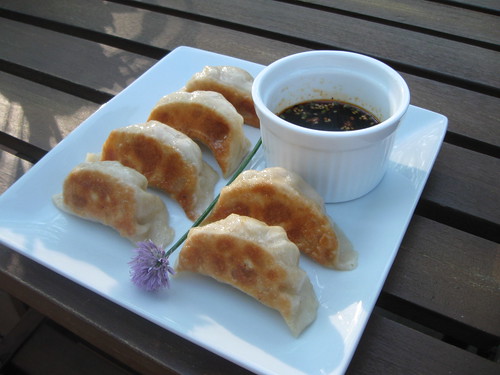


Chinese Dumplings/Potstickers

pork filling:

  • 1 lb (450g) ground pork
  • 4 large napa cabbage leaves, minced
  • 3 stalks green onions, minced
  • 7 shitake mushrooms, minced (if dried - rehydrated and rinsed carefully)
  • 1/2 cup (75g) bamboo shoots, minced
  • 1/4 (55g) cup ginger root, minced
  • 3 tbsp (40g) soy sauce
  • 2 tbsp (28g) sesame oil
  • 2 tbsp (16g) corn starch

dipping sauce:

  • 2 parts soy sauce
  • 1 part vinegar (red wine or black)
  • a few drops of sesame oil
  • chili garlic paste (optional)
  • minced ginger (optional)
  • minced garlic (optional)
  • minced green onion (optional)
  • sugar (optional)

Combine all filling ingredients in a large mixing bowl and mix thoroughly. Cover and refrigerate until ready to use (up to a day, but preferably within an hour or two).

Make the dough: In a large bowl mix flour with 1/4 cup of water and stir until water is absorbed. Continue adding water one teaspoon at a time and mixing thoroughly until dough pulls away from sides of bowl. We want a firm dough that is barely sticky to the touch.

Knead the dough about twenty strokes then cover with a damp towel for 15 minutes. Take the dough and form a flattened dome. Cut into strips about 1 1/2 to 2 inches wide. Shape the strips into rounded long cylinders. On a floured surface, cut the strips into 3/4 inch pieces. Press palm down on each piece to form a flat circle (you can shape the corners in with your fingers). With a rolling pin, roll out a circular wrapper from each flat disc. Take care not to roll out too thin or the dumplings will break during cooking - about 1/16th inch. Leave the centers slightly thicker than the edges. Place a tablespoon of filling in the center of each wrapper and fold the dough in half, pleating the edges along one side (see images in post for how to fold pleats). Keep all unused dough under damp cloth.

To boil: Bring a large pot of water to a boil and add dumplings to pot. Boil the dumplings until they float.

To steam: Place dumplings on a single layer of napa cabbage leaves or on a well-greased surface in a steamer basket with lid. Steam covered for about 6 minutes.

To pan fry (potstickers): Place dumplings in a frying pan with 2-3 tbsp of vegetable oil. Heat on high and fry for a few minutes until bottoms are golden. Add 1/2 cup water and cover. Cook until the water has boiled away and then uncover and reduce heat to medium or medium low. Let the dumplings cook for another 2 minutes then remove from heat and serve.

Can't wait to see what the Daring Cooks have in store next month!

Pork Potstickers on Foodista

My cookbook review in the Daring Kitchen!

I must say I feel a bit famous. Yesterday, a cookbook review I wrote went live on the Daring Kitchen website. Those of you who follow my blog will not be surprised to learn that I reviewed one of my favorite cookbooks: Bistro Laurent Tourondel: New American Bistro Cooking.

Check out the review in the Daring Kitchen. And while you're there have a look around!

Friday, June 12, 2009

Last supper #16: Jonathan Waxman

I know, I know. I've been really bad about my Last Supper posts. But this is a good one. For his last supper, Chef Jonathan Waxman of Barbuto in New York City, listed a number of our favorites: Grilled spring lamb, gnocchi with truffles, and grilled porcini salad, among other things.
I prepared the lamb our favorite way. I marinate the rack for several hours in a mixture of salt, pepper, olive oil, garlic, more garlic and lots of fresh rosemary. Then my grill-master husband takes over and grills it until it's charred but still pink and juicy! delish!
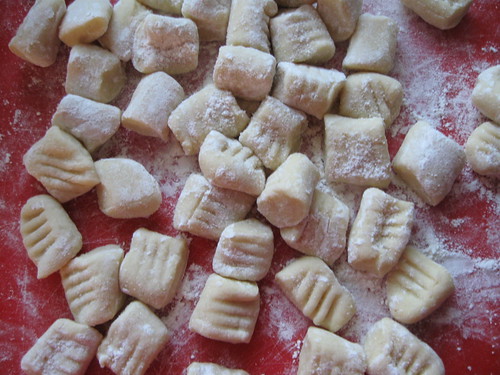
I also made the gnocchi from scratch. This was my second attempt at homemade gnocchi and these turned out better than the first. It does help when the potatoes are sufficiently cooked :)

I boiled them and then tossed them into a saute pan with a little butter, olive oil and garlic. (I always cut butter with olive oil to reduce the fat. You still get the nice buttery flavor, but less saturated fat). I added some sea salt and just before serving I sprinkeld with chopped truffled and shaved Parmigiano-Reggiano. I finished it with a touch of white truffle oil.
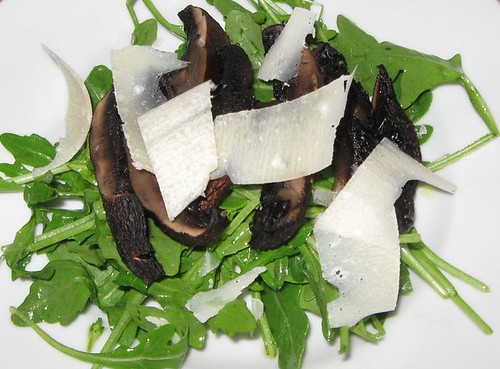
The Porcini salad was really a portabello salad. Try though I might I couldn't find porcinis. So I drizzled a little olive oil, salt and pepper on a few portabello caps and then we grilled them. Here's my recipe:

Grilled Portabello Salad with shaved Parmigiano-Reggiano
  • 2 Portabello mushroom caps
  • Extra Virgin Olive Oil
  • Sea Salt
  • Fresh ground black pepper
  • Small bunch of fresh baby arugula
  • 2 tsp. fresh squeezed lemon juice
  • Parmigiano-Reggiano
Gently clean the mushroom caps then rub each with a little Extra virgin olive oil and sprinkle both sides with salt and pepper. Grill over medium heat until just cooked thru, a couple minutes a side. Remove from grill.

Prepare the dressing. Whisk together 2 tablespoons extra virgin olive oil and the lemon juice. Season to taste with salt and pepper.
To serve, pour just enough dressing on the arugula to gently coat it. Pile the arugula on two plates. Slice the mushrooms and arrange over the arugula. Top each with a good amount of fresh shaved Parmigiano-Reggiano.

Grilled Portabello Salad With Shaved Parmigiano-Reggiano on Foodista

Tuesday, June 9, 2009

Tapas for two: a taste of Spain at home

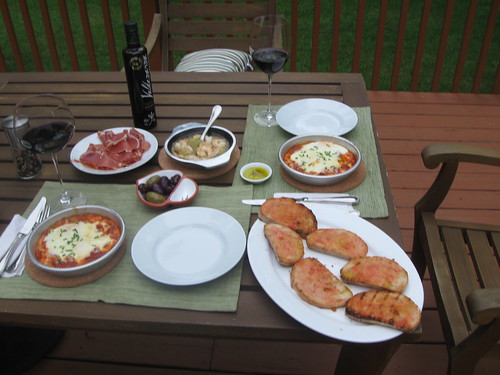
I'm a Food Network junkie. I admit it. I love those shows - some of them at least. My new favorite is Chef Anne Burrell's Secrets of a Restaurant Chef. I first became familiar with Burrell in her role a sous chef to Mario Batali on Iron Chef America. On Secrets, she makes a wide range of restaurant dishes at home. Her energy is great and the flavors are phenomenal - and things anyone can try at home. I caught an episode on tapas a few weeks ago and as I watched, I knew I had to make this meal.


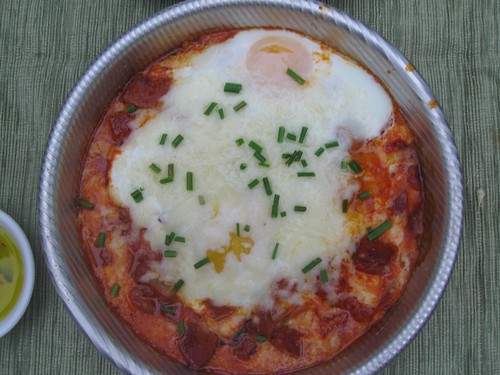
My husband and I went to Spain last year and more recently to Mario Batali's Casa Mono (twice). So we have tapas-fever. As I watched Chef Burrell make Eggs Flamenco, Catalan Toasts and Shrimp in Garlic Sauce, I was whisked away to Barcelona. The ingredients and recipes are easy and the flavors big and bold. I've put the recipe for the eggs below as well as the method for the bread, and you can find the recipe for the shrimp on the FN website. (note, I added some smoked hot paprika to mine for added flavor and color).

Last Saturday, I decided to turn our home into Spain. As Jeff worked in the yard, I turned the kitchen into tapas-central. To make this meal, start the sauce for the eggs first. As it simmers, prep the shrimp and set the table. Then, while the eggs are in the oven, grill the bread and cook the shrimp. Perfect-o!

And who heard of Tapas without Spanish wine??? We had some 2006 Quiteria Loma Gorda - this is a Spanish Granache Syrah that we got a the Wine Library and I've bought it repeatedly. (At $11.98 a bottle, why not??) Or try your favorite Rioja or a glass of cool sangria!


Eggs Flamenco
Recipes from Chef Anne Burrell, on Foodnetwork.com

  • Extra-virgin olive oil
  • 1 onion, diced
  • Kosher salt
  • 2 garlic cloves, smashed and chopped
  • 1 cup (1/2-inch) diced Spanish chorizo
  • 1 teaspoon pimenton
  • 1 (28-ounce) can plum tomatoes, coarsely chopped with their juice or passed through a food mill
  • 8 eggs
  • 1/2 cup finely grated aged manchego
  • 2 tablespoons chopped chives

Directions
Special Equipment: 4 (6-inch wide) flat ovenproof dishes such as terra cotta cazuelas

Coat a saucepan with olive oil, add the onions and bring to a medium heat. Season the onions with salt and sweat for 7 to 8 minutes or until the onions are soft and very aromatic. Add the garlic and cook for 2 to 3 more minutes. Add the chorizo and pimenton and cook for another 2 to 3 minutes. Add the tomatoes and season with salt. Simmer for 15 to 20 minutes. Taste for seasoning and adjust, if needed.

Preheat the oven to 400 degrees F.

Oil the cazuelas. Fill each dish about halfway with the tomato sauce. Break 2 eggs into each dish and sprinkle with grated cheese. Place the cazuelas into the preheated oven and bake until the egg whites are set but the yolks are still runny, about 8 minutes.
When the eggs are done, sprinkle with chives and serve.


Catalan Toasts

  • 1 ripe tomato
  • 6 thick, bias cut, slices baguette
  • 2 garlic cloves
  • Extra-virgin olive oil, preferably Spanish
  • Kosher salt
  • 6 slices serrano ham (you can sub prosciutto if you can't get Serrano).

Directions
Preheat the grill to medium.
Cut the tomato in half and grate it on the coarse side of a box grater. Reserve the tomato pulp.
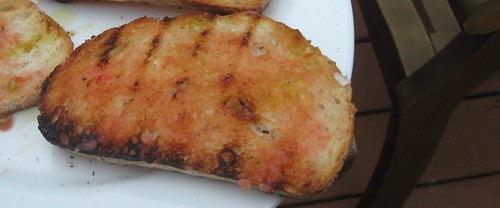
Grill the bread slices on both sides until they are slightly charred. When the bread comes off the grill rub each slice with a garlic clove and drizzle generously with olive oil. Top each toast with tomato pulp and a tiny sprinkle of salt. Cover tomato with a slice of ham and serve.

Wednesday, June 3, 2009

Moroccan Fish Tagine: A New Favorite!

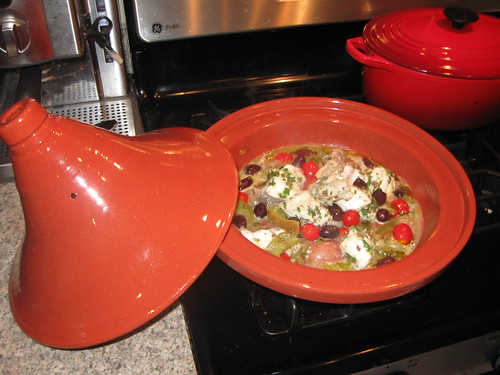
I'm not sure how my husband managed to eat this meal since he seemed to spend the whole time singing its praises... but there wasn't a scrap left in his dish at the end. About 6 months ago, my sister gave me an authentic Moroccan tagine - a terracotta pot with a cone-shaped lid. The lid has a single little hole in one side near the top to let just a little steam out. Most of the moisture stays inside, creating moist tender dishes. So far, I've only used it for chicken. But she also gave me a copy of Ghillie Basan's cookbook called Tagine: Spicy Stews from Morocco, so I decided to give this one a go.

The ingredients are pretty basic, so don't let the fact that it is Moroccan deter you. No tagine? Just use a heavy pot with a lid. (It won't look as cool on the stove, but it'll taste great.)


Tagine of Monkfish, Potatoes, Cherry Tomatoes and Black Olives
adapted from Tagine: Spicy Stews from Morocco by Ghillie Basan


  • About 1 lb. monkfish, cut into chunks
  • 4 new potatoes
  • 3 Tbsp. Olive oil
  • 1 pat of butter
  • 3-4 garlic cloves, thinly sliced
  • 12-16 cherry or grape tomatoes
  • about 12 fleshy black olives - I used Kalamata
  • 1 green bell pepper, broiled until black, peeled and then cut into strips
  • sea salt and freshly ground black pepper
  • lemon wedges, to serve
For the Chermoula

  • 2 cloves garlic
  • 1 tsp. coarse salt
  • 1 heaping tsp. cumin seeds
  • 1 red or green chile, seeded and chopped
  • freshly squeezed juice of one lemon
  • 2 Tbsp. olive oil
  • a small bunch of fresh cilantro, roughly chopped

First, make the chermoula. Using a mortar and pestle, pound the garlic with the salt to a smooth paste. Add the cumin and chile and mash a bit. Add the lemon juice and olive oil. Finally, stir in the cilantro. Put the fish in a shallow dish and rub it with about three quarters of the chermoula. Cover and marinate in the refrigerator for 1-2 hours. Reserve the remaining chermoula.

Meanwhile, bring a saucepan of water to a boil and drop in the potatoes. Boil vigorously until almost cooked, but still a bit hard - the original recipe says 8 minutes for small potatoes. I did mine about 11 but probably could have let them go a minute or two longer. Remove them from the water and set aside.

Heat 2 tablespoons of the oil with the pat of butter in the bottom of a tagine or heavy bottomed pan. Add the garlic and stir. When the garlic starts to brown, add the tomatoes to soften them a bit. Add the peppers and the reserved chermoula. Season to taste with salt and pepper. Tip this mixture onto a plate.

Arrange the potatoes over the bottom of the tagine and spread half of the tomato mixture over them. Place the chunks of marinated fish over the center then spoon the rest of the tomato mixture over the top. Tuck the olives in around the fish and drizzle with the remaining tablespoon of olive oil. Pour in about 1/2 cup of water. Cover and let steam for 15-20 minutes, until the fish and potatoes are cooked through. Serve immediately with lemon wedges.


Tagine Of Monkfish, Potatoes, Cherry Tomatoes and Black Olives on Foodista

Tuesday, June 2, 2009

Southwest Pork Kabobs: a new summertime favorite

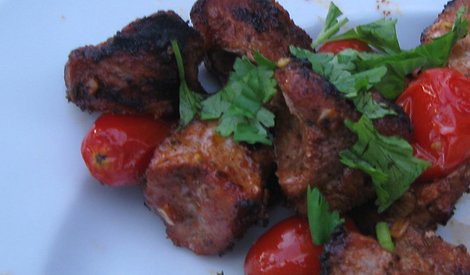
Recently, I was perusing my copy of Weber's Real Grilling and came across a recipe for Southwest Pork Kabobs with GrapeTomatoes. A quick read of the ingredients put this on my must-try list. So, last night, we tried! And they were delish! Garnished with fresh chopped cilantro and a lime wedge, they also make a pretty presentation. Make the marinade in the morning and then dinner's almost ready when you get home!

Find my adaptation of the recipe below the picture! You can leave out the Pimenton. The original doesn't call for it but I love the smoky flavor and the heat!


Southwest Pork Kabobs with Grape Tomatoes

Marinade:

  • Juice of one orange (about 1/2 cup)
  • 3 Tbsp. Extra Virgin Olive Oil
  • 2 Tbsp. Red Wine Vinegar
  • 1 Tbsp. minced garlic
  • 2 tsp. Ancho Chile powder
  • 1 1/2 tsp. Hot Pimenton (smoked paprika) - optional or use sweet smoked paprika if you don't like spicy!
  • 1 tsp. dried oregano
  • 1 tsp. ground cumin
  • 1 tsp. Kosher salt
  • 1/2 tsp. fresh ground black pepper
  • 1/4 tsp. ground cinnamon
  • 2 lbs. Pork loin, trimmed and cut into 1 inch cubes
  • 1 pint grape tomatoes
  • Lime wedges
  • Chopped cilantro

Combine all of the marinade ingredients in a non-reactive dish or resealable bag. Add the pork and toss to coat thoroughly. Stick it in the fridge for at least an hour (I made it in the morning and let it marinate while at work).

Just before cooking, preheat grill on high. Thread pork and tomatoes onto skewers, alternating them. Discard excess marinade.

Grill on high direct heat for 6-8 minutes, turning frequently. On our BBQ, these took 8 minutes. They char beautifully but don't get dry. Serve with lime wedges and sprinkle with cilantro.


Thursday, May 28, 2009

May Daring Bakers Challenge: Apple Strudel

The May Daring Bakers’ challenge was hosted by Linda of make life sweeter! and Courtney of Coco Cooks. They chose Apple Strudel from the recipe book Kaffeehaus: Exquisite Desserts from the Classic Cafés of Vienna, Budapest and Prague by Rick Rodgers.

(photos coming soon)

I must admit I struggled with this one... If you give it a try, be sure the dough gets super thin or it'll come out like mine did - a little tough. All in all it was a fun recipe to try and I'd certainly give it another go, especially since my first wasn't a huge success!

Preparation timeTotal: 2 hours 15 minutes – 3 hours 30 minutes
15-20 min to make dough
30-90 min to let dough rest/to prepare the filling
20-30 min to roll out and stretch dough
10 min to fill and roll dough30 min to bake
30 min to cool


Apple strudelfrom “Kaffeehaus – Exquisite Desserts from the Classic Cafés of Vienna, Budapest and Prague” by Rick Rodgers

2 tablespoons (30 ml) golden rum

3 tablespoons (45 ml) raisins
1/4 teaspoon ground cinnamon
1/3 cup plus 1 tablespoon (80 g) sugar
1/2 cup (1 stick / 115 g) unsalted butter, melted, divided
1 1/2 cups (350 ml) fresh bread crumbsstrudel dough (recipe below)
1/2 cup (120 ml, about 60 g) coarsely chopped walnuts
2 pounds (900 g) tart cooking apples, peeled, cored and cut into ¼ inch-thick slices (use apples that hold their shape during baking)

1. Mix the rum and raisins in a bowl. Mix the cinnamon and sugar in another bowl.
2. Heat 3 tablespoons of the butter in a large skillet over medium-high. Add the breadcrumbs and cook whilst stirring until golden and toasted. This will take about 3 minutes. Let it cool completely.
3. Put the rack in the upper third of the oven and preheat the oven to 400°F (200°C). Line a large baking sheet with baking paper (parchment paper). Make the strudel dough as described below. Spread about 3 tablespoons of the remaining melted butter over the dough using your hands (a bristle brush could tear the dough, you could use a special feather pastry brush instead of your hands). Sprinkle the buttered dough with the bread crumbs. Spread the walnuts about 3 inches (8 cm) from the short edge of the dough in a 6-inch-(15cm)-wide strip. Mix the apples with the raisins (including the rum), and the cinnamon sugar. Spread the mixture over the walnuts.
4. Fold the short end of the dough onto the filling. Lift the tablecloth at the short end of the dough so that the strudel rolls onto itself. Transfer the strudel to the prepared baking sheet by lifting it. Curve it into a horseshoe to fit. Tuck the ends under the strudel. Brush the top with the remaining melted butter.
5. Bake the strudel for about 30 minutes or until it is deep golden brown. Cool for at least 30 minutes before slicing. Use a serrated knife and serve either warm or at room temperature. It is best on the day it is baked.


Strudel doughfrom “Kaffeehaus – Exquisite Desserts from the Classic Cafés of Vienna, Budapest and Prague” by Rick Rodgers

1 1/3 cups (200 g) unbleached flour
1/8 teaspoon salt7 tablespoons (105 ml) water, plus more if needed
2 tablespoons (30 ml) vegetable oil, plus additional for coating the dough
1/2 teaspoon cider vinegar

1. Combine the flour and salt in a stand-mixer fitted with the paddle attachment. Mix the water, oil and vinegar in a measuring cup. Add the water/oil mixture to the flour with the mixer on low speed. You will get a soft dough. Make sure it is not too dry, add a little more water if necessary.Take the dough out of the mixer. Change to the dough hook. Put the dough ball back in the mixer. Let the dough knead on medium until you get a soft dough ball with a somewhat rough surface.
2. Take the dough out of the mixer and continue kneading by hand on an unfloured work surface. Knead for about 2 minutes. Pick up the dough and throw it down hard onto your working surface occasionally.Shape the dough into a ball and transfer it to a plate. Oil the top of the dough ball lightly. Cover the ball tightly with plastic wrap. Allow to stand for 30-90 minutes (longer is better).
3. It would be best if you have a work area that you can walk around on all sides like a 36 inch (90 cm) round table or a work surface of 23 x 38 inches (60 x 100 cm). Cover your working area with table cloth, dust it with flour and rub it into the fabric. Put your dough ball in the middle and roll it out as much as you can.Pick the dough up by holding it by an edge. This way the weight of the dough and gravity can help stretching it as it hangs. Using the back of your hands to gently stretch and pull the dough. You can use your forearms to support it.
4. The dough will become too large to hold. Put it on your work surface. Leave the thicker edge of the dough to hang over the edge of the table. Place your hands underneath the dough and stretch and pull the dough thinner using the backs of your hands. Stretch and pull the dough until it's about 2 feet (60 cm) wide and 3 feet (90 cm) long, it will be tissue-thin by this time. Cut away the thick dough around the edges with scissors. The dough is now ready to be filled.

Related Posts with Thumbnails